
 Menu
Five axis machining means the cutting tool can approach the part from almost any direction while it is held in a single setup. For a complex component, that one change removes most of the ways a part goes wrong.
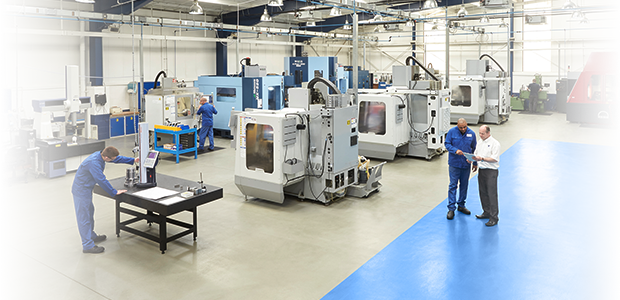
WLR program up to five simultaneous axes directly from your 3D model files, at our works in Nottingham.
Why one setup matters more than the axis count
Every time a part is unclamped and refixtured, a small error is introduced. Machine a component across four setups and those errors stack — not catastrophically, but enough that a feature on face one no longer relates correctly to a feature on face four.
Machining in one setup removes that accumulation entirely. It also removes the fixturing cost, the handling time and the risk of damage between operations. On a complex part the saving in time is real, but the saving in scrap is usually the bigger number.
It is also the only practical way to machine some geometries at all: undercuts, compound angles, impeller and manifold forms, and anything where the tool has to reach round the part rather than straight at it.
How we hold position through a long run
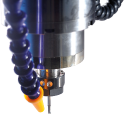
All our milling machines carry Renishaw probing and laser tool measurement. The probe checks the part is where the program thinks it is before cutting starts, and the laser measures the tool rather than assuming it.
That is what makes an unattended run trustworthy. The first part off being correct is not difficult; the hundredth being identical is the thing customers are actually paying for.
We also use System 3R workholding, which means a fixtured part can come off the machine and go back on in a known position — useful when a job has to pause for a treatment and return.
Programming from your models
Send a 3D model and we program from it directly. There is no re-drawing stage, so a revision does not restart the process, and we retain the CNC program afterwards — if the part comes round again, we are not starting from nothing.
Where it is usually worth it
Five axis is not automatically the right answer. A simple part in a long run is often cheaper on a three axis machine, and we will tell you if that is the case.
It earns its cost when the part has features on multiple faces, when the tolerance between those features is tight, when the geometry needs tool access that three axes cannot give, or when the part is expensive enough in material that scrapping one at operation four is unacceptable. Nickel alloy and titanium components tend to meet that last test on their own.
Send us the model
A 3D model, the quantity, the material and any finish requirement is enough to quote from. If you are not sure whether a part needs five axes, send it anyway and we will tell you.
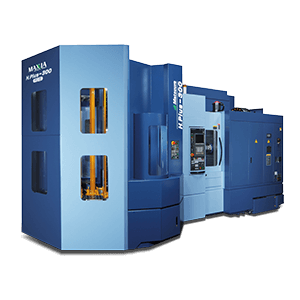

 KERN Pyramid Nano Machining Centre